
A battery’s nameplate tells you how much energy it is rated to store. It does not automatically tell you how much energy your equipment can draw. When comparing battery storage quotes, ask for usable energy at the point where your loads are connected, at a stated discharge power and with the same starting charge and reserve settings.
That distinction matters when an outage plan calls for four hours of backup. An attractive capacity number can leave the site short if it describes nominal DC energy, while the four-hour requirement is measured at an AC load panel.
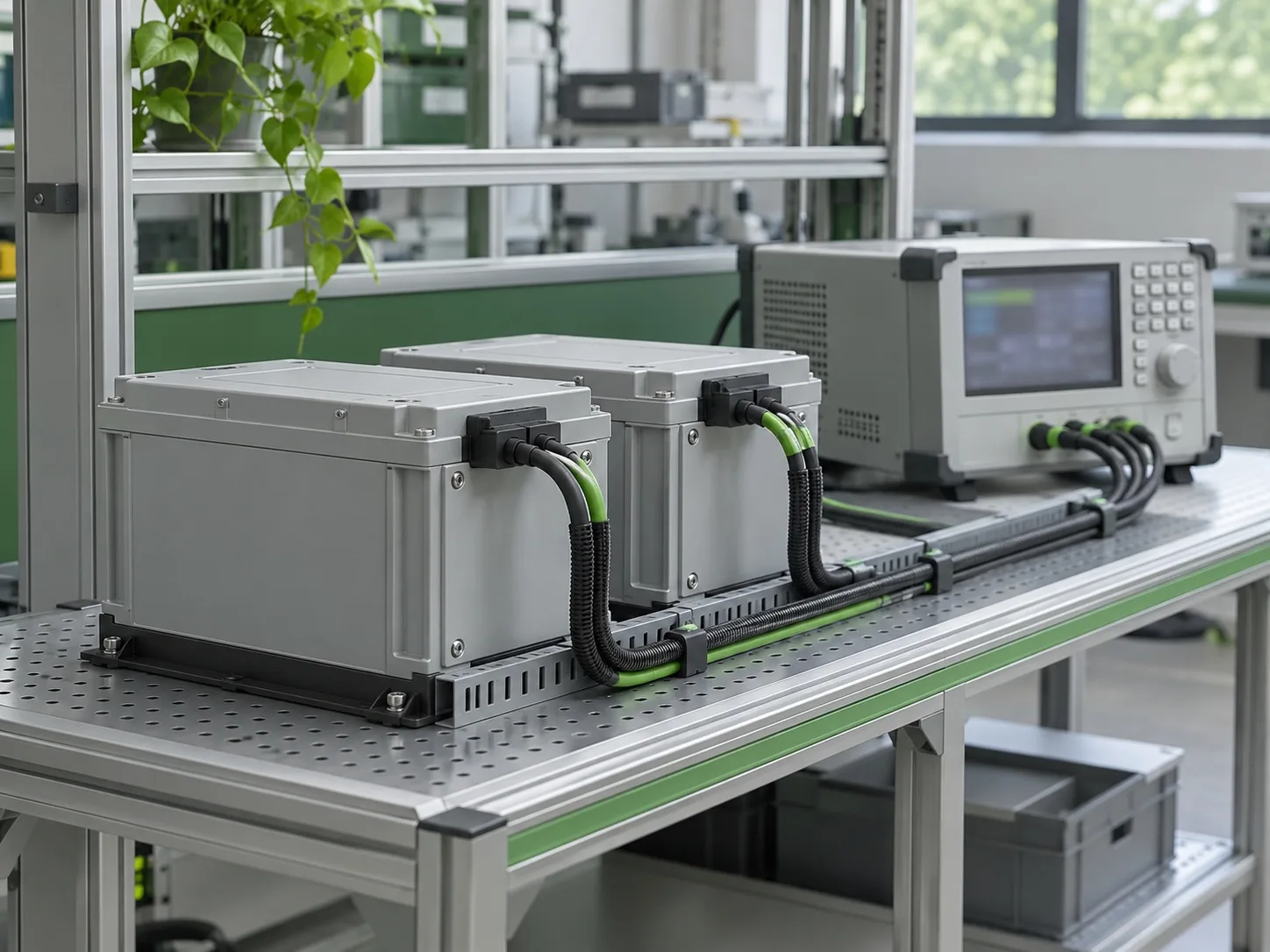
Put each energy figure at the right boundary
The U.S. Department of Energy’s BESS evaluation method uses measured charge and discharge data to evaluate storage performance. For a quote comparison, use the same principle: define where the meter is and what it counts.
| Figure in the quote | What it tells you | What to ask next |
|---|---|---|
| Nominal battery energy | The rated energy of the battery, often expressed on the DC side | Is this for one module or for the full bank? |
| Usable DC energy | The energy available within a defined operating window at the battery terminals | What state-of-charge limits, discharge power and temperature apply? |
| Delivered AC energy | The energy measured at the selected AC output over the discharge | Are inverter losses and relevant auxiliary loads included? |
| Continuous output power | How much power the system can supply at a given time | Does the rating apply in backup mode and at the site temperature? |
Amp-hours describe electric charge, so compare amp-hour figures only with their voltage. For example, 51.2 V × 100 Ah gives 5.12 kWh of nominal energy. It does not establish that 5.12 kWh will reach an AC circuit. Also check whether a supplier has already deducted a protected reserve from its usable figure. Deducting it again understates the available energy.
Compare two offers against the same four-hour requirement
Suppose a site has a steady 0.9 kW of critical AC loads for four hours, with no solar contribution or charging during the outage. The loads need 3.6 kWh at the AC panel. Assume both proposed inverters meet the continuous and startup power requirements.
Offer A lists 5.12 kWh nominal DC. For this example only, assume the permitted operating window gives access to 80% of the nameplate and 90% of that available DC energy reaches the selected AC output. The screening calculation is 5.12 × 0.80 × 0.90 = 3.69 kWh. That leaves only 0.09 kWh above the requirement, before any separately counted auxiliary consumption or degradation allowance. It is a marginal planning result.
Offer B states 4.2 kWh delivered AC under the agreed test conditions and reserve settings. It leaves 0.6 kWh above the requirement on the same comparison basis. If that figure is already measured at the agreed point, do not apply inverter efficiency again. Neither offer is a Green Batt test result or a proposed operating setting.
Do not substitute round-trip efficiency for the discharge-only factor in Offer A. Round-trip efficiency compares energy out with energy put in across a complete charge–discharge cycle. It does not isolate the conversion and standby losses during discharge. Enphase’s explanation of battery efficiency illustrates why an AC-to-AC number and a DC-side number need different interpretations.
Write the acceptance condition into the quote request
- Measurement point: Identify the backup panel or inverter output where delivered energy is measured. Agree whether system auxiliaries and external loads are inside that boundary.
- Operating conditions: State the required load profile, ambient range, starting state of charge, permitted endpoint and whether charging is available during the test.
- Pass criterion: For the example above, ask the supplier to demonstrate the agreed load for four hours at the AC panel and record delivered kWh, power and final state of charge.
- Service-life margin: Ask whether the quoted energy applies to a new system only, and request the basis for any capacity allowance at a later service point.
When reviewing a Green Batt configuration, start with the battery product range, then share the load and reserve requirements so proposals can be compared at the same boundary.
Frequently Asked Questions
Does a 5 kWh battery run a 1 kW load for five hours?
Only if 5 kWh is available at the load boundary and the system can supply 1 kW continuously for that period. A 5 kWh nominal battery rating alone does not establish either condition.
Should I always subtract inverter losses from usable capacity?
No. Subtract conversion losses only if the stated usable energy is measured upstream of the conversion. If the figure already describes delivered energy at the same AC point, another deduction would count the loss twice.
Can I compare two usable-energy figures measured at different powers?
Only as a rough screen. Ask for comparable discharge power, temperature, reserve settings and metering boundaries before treating the difference as a product advantage.
Need help with a similar request?
Share your product requirements, timeline and cooperation goals. We can help clarify the next step.