
A 51.2 V lithium iron phosphate (LiFePO4) battery can be suitable for some equipment marketed as a 48 V inverter. The labels alone are insufficient. A workable match needs an approved battery voltage window, enough current at the low end of that window, and a control method that both manufacturers support.
For purchasing, ask for the exact battery and inverter model numbers, their firmware versions and a connection or compatibility document. A reference to a brand or a “48 V class” is too broad to make the decision.
Start with the voltage window
Nominal voltage is a reference value. Actual DC voltage changes during charge and discharge and can sag under load. Compare the inverter’s permitted DC operating range and charge settings with the battery’s specified limits. Also ask how the inverter’s normal shutdown and restart points coordinate with the battery management system (BMS). Routine operation should respect the approved operating window rather than repeatedly reaching a hard protection cutoff.
Check both directions of power flow. A battery that can supply the inverter during discharge still needs a supported way to charge from every enabled source. The combined charge from an inverter/charger and a separate solar controller can matter more than either rating alone.
Check the current where voltage is lowest
At the same AC output, the inverter draws more DC current as battery voltage falls. As an illustrative check, suppose the inverter supplies 4 kW AC at 92% discharge conversion efficiency, with 46 V at its DC input under load. The estimated current is 4,000 ÷ (46 × 0.92), or about 95 A. Calculating at the nominal 51.2 V would give about 85 A. These are hypothetical conditions; neither voltage nor current is a recommended Green Batt setting.
A battery rated for 90 A continuous would look sufficient in the nominal-voltage calculation and fail this lower-voltage screening case. Check the battery’s permitted continuous and peak currents and their durations, its limits at the intended temperature and state of charge, and the inverter’s own ratings. If you need parallel modules to meet the requirement, confirm that the manufacturer supports that exact arrangement and how it handles one module dropping out. Do not assume that adding two modules doubles allowable current in every condition.
Treat the BMS link as a compatibility requirement
In a managed installation, the BMS can provide the inverter with live charge and discharge limits, state of charge and alarms. A CAN or RS485 label identifies the communication interface; it does not prove that two devices use the same messages, connection pinout or firmware.
Victron’s compatibility documentation provides model-specific examples of this distinction. Its documented Voltsmile integration, for instance, identifies required devices and firmware. That pairing is an example of what evidence to request, not an approval for a Green Batt model.
| What the supplier says | What to verify before ordering |
|---|---|
| “Both are 48 V class” | Operating voltage range, charge limits and restart behavior |
| “It supports CAN” | Exact protocol, required cable, port and supported firmware |
| “The battery is 100 Ah” | Continuous and peak current under the expected conditions |
| “Two batteries can be paralleled” | Approved topology, module count, coordination and failure behavior |
| “It works without communication” | Written support for voltage-controlled mode and who sets protection and charging limits |
Ask the integrator to confirm behavior during commissioning
Use the manufacturers’ documentation and a qualified installer for commissioning. Ask the installer to confirm that the inverter sees plausible battery status and limits, and behaves as documented when loads change, charging resumes after a cutoff, or communication is lost. Agree beforehand on which behaviors can be checked through the approved commissioning procedure and what evidence the installer should record.
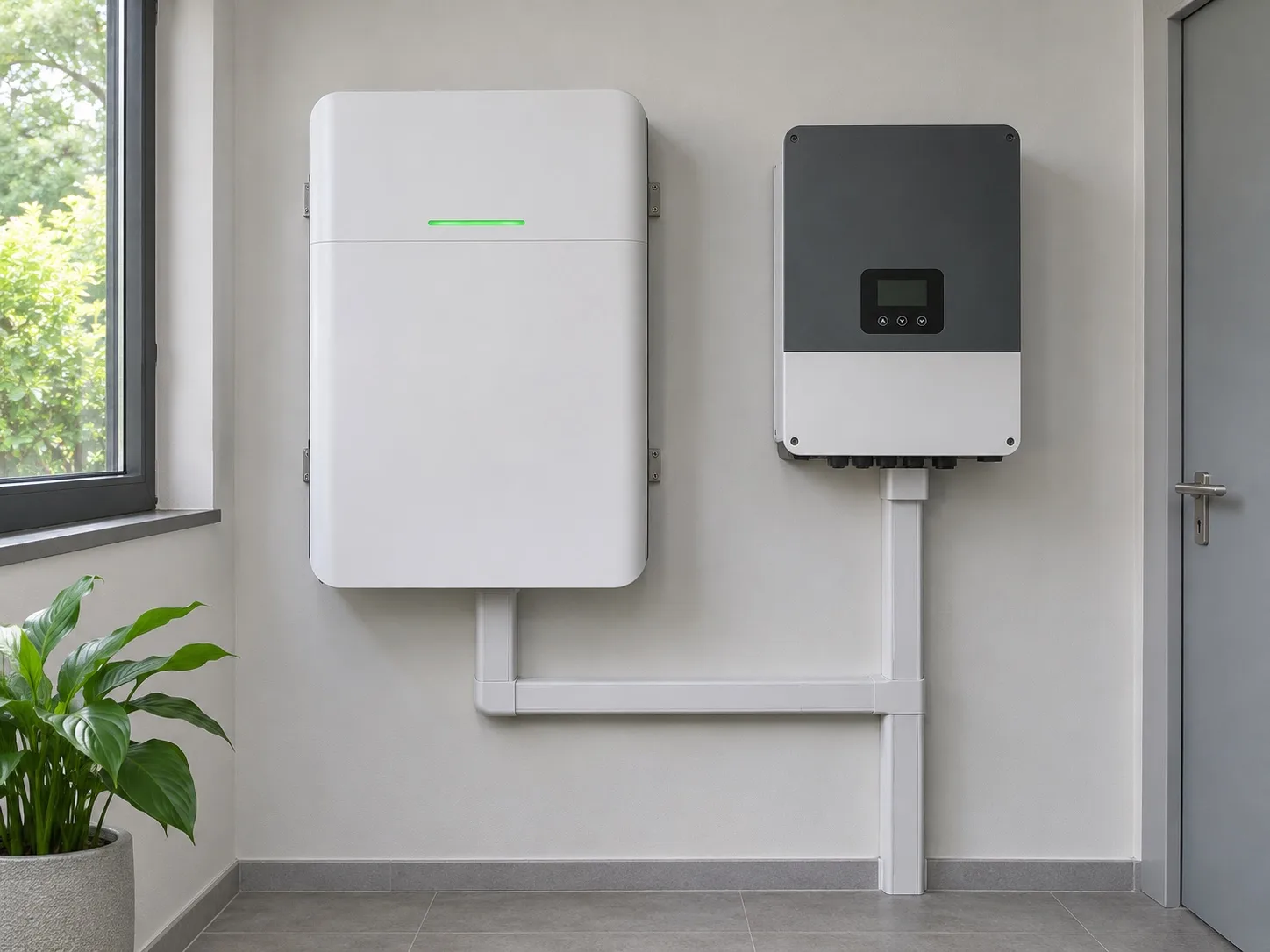
For an initial product review, see Green Batt’s 51.2 V wall-mounted battery range and send the exact inverter model and load requirements. Verify the proposed pairing before placing an order.
Frequently Asked Questions
Is every 51.2 V LiFePO4 battery interchangeable with a 48 V battery?
No. The operating limits, current capability, communication requirements and approved protection settings can differ despite similar nominal labels.
Does an RJ45-style plug tell me the BMS cable is compatible?
No. Connector shape does not identify pinout or protocol. Use the cable and connection instructions for the documented pairing.
Can a larger inverter solve a battery current limit?
No. A higher inverter rating does not raise the current the battery is allowed to deliver. Limit the supported load or select an approved battery configuration with sufficient current capability.
Need help with a similar request?
Share your product requirements, timeline and cooperation goals. We can help clarify the next step.