
Before relying on a portable power station for a full shift, test the actual devices together. A useful trial answers two separate questions: Will the station start the most demanding device while the others are running? And how much energy does the group consume over a representative work period?
A watt-hour rating answers neither question by itself. A station can have enough energy for five hours and still shut down when a compressor restarts. It can also start every device and run out of energy long before the shift ends.
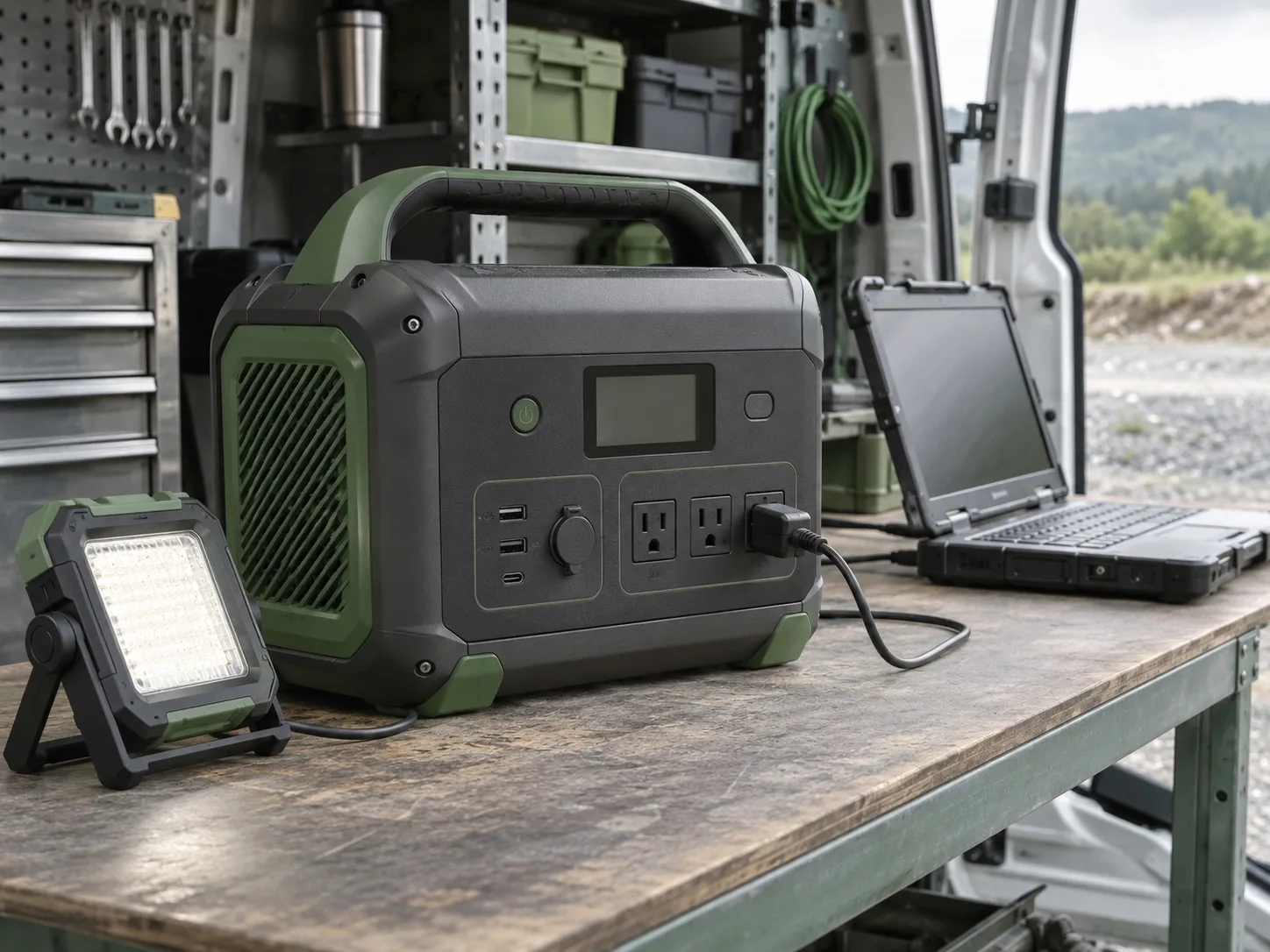
Build the test around the job
List the loads by output: AC outlets, USB ports or an approved DC connection. For each device, note its normal operating period, standby periods and whether it starts automatically. Include small loads that stay on all day, such as a router or task light. Check the station manual for each output and any combined output limits. A plug that fits does not establish electrical compatibility.
For plug-in AC appliances within the meter’s rating, log watt-hours with a suitable energy meter. Choose a test duration long enough to capture normal behavior. A fridge or cooler may run longer after warm loading or door openings than after it settles at temperature. Record the conditions and include the real work pattern. A brief reading taken while the compressor is off will undercount energy, while treating its full running draw as constant can overcount it.
An ordinary energy meter may not catch short inrush peaks. Use the equipment documentation, suitable measurement by a qualified technician, or a supervised trial with the intended station and appliances. EcoFlow’s refrigeration sizing guide distinguishes running draw, startup and compressor cycling; its product-specific examples do not establish Green Batt ratings.
A five-hour field setup, worked through
Consider this hypothetical AC load record for a sheltered service bench:
| Load | Observed behavior in the example | Energy over the session |
|---|---|---|
| Small cooler | 90 W while running, 1.4 hours total | 126 Wh |
| Task lighting | 16 W for five hours | 80 Wh |
| Laptop charger | 36 W average for three hours | 108 Wh |
| Total | Measured or estimated at the equipment | 314 Wh |
With all three drawing the listed power at the same time, the continuous load is about 142 W. If the cooler’s total draw reaches 360 W while starting and the two other loads are drawing 52 W, the station briefly sees about 412 W. The 360 W already includes the cooler’s startup draw; do not add its 90 W running figure again. Check the peak’s duration against the station’s specified overload capability, and remember that an average charger reading may conceal higher moments.
The 314 Wh figure is the energy the loads need, not the station capacity you should order. The AC inverter and station electronics also use energy. You can compare 314 Wh with measured delivered AC energy under similar loads. If you have only nominal battery watt-hours, use the number for screening and test the complete system before relying on it. Do not assume solar or vehicle charging will make up a shortfall unless the charging opportunity is part of the verified plan.
What a useful trial should record
- Start from the charge you can actually guarantee. Record the starting charge, ambient conditions and the operating modes or idle timers you intend to use.
- Check normal simultaneous restarts. Run the background equipment and observe the cooler when it cycles naturally. Check for trips, unexpected resets or a load that fails to restart.
- Run a representative session. Record elapsed time, delivered energy if metered, and the ending charge. Repeat if the job has a hotter, longer or otherwise more demanding shift.
- Set a reserve before leaving. Agree on a minimum ending charge and on which loads can be removed if conditions change. If the trial misses the target, reduce the load or choose more usable energy; if startup fails, review surge compatibility separately.
Use Green Batt’s portable and off-grid application guide to compare the available formats. Bring the test record when discussing a station for a repeatable field setup.
Frequently Asked Questions
Why can the station shut off while a cooler is still connected?
Some stations have configurable inactivity or low-load shutoff behavior. Check the specific manual and include a normal idle cycle in the test. Also check the event log or protection indication before attributing the shutdown to the timer.
Can I calculate a safe runtime from the appliance nameplate alone?
Use it as a first screen. Duty cycle, startup, the mix of output ports and station overhead can change the result. Meter the actual workload to establish a planning figure.
Will a station that starts each device separately start them together?
Not necessarily. The inverter must support the background draw plus the starting device’s demand, and multiple loads can restart at the same time. A representative system test is more useful than separate startup checks.
Need help with a similar request?
Share your product requirements, timeline and cooperation goals. We can help clarify the next step.